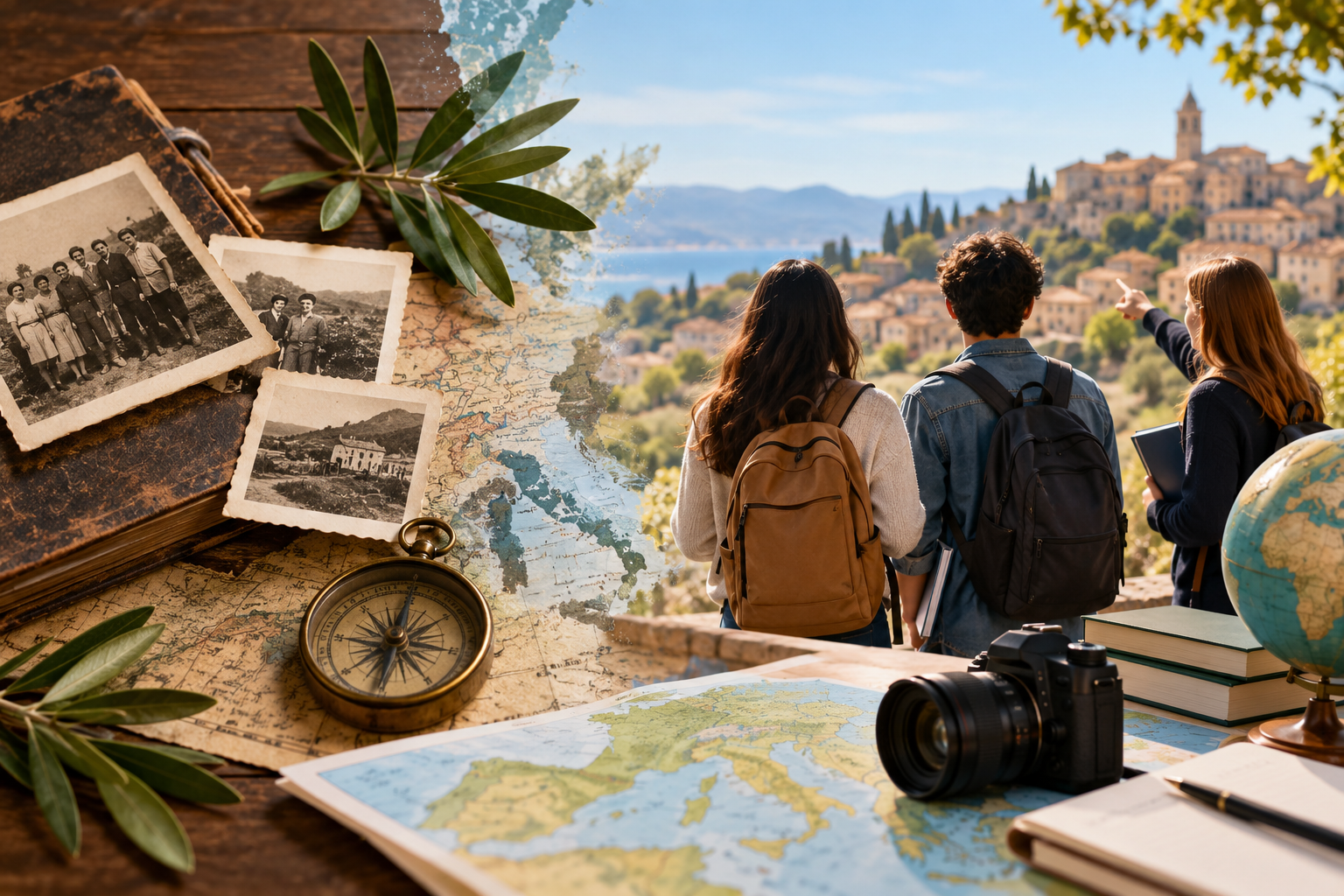
Roots tourism can be usually considered a linkage between origins of ones, the genuine interest, and discovering the world as it is.
Providing the knowledge, skills and opportunities
The very first step could easily be done in schools as it is the place where we spent a great piece of our lives. Of course it is not only teachers and schools responsibility to make one eager to get to know their own roots or help the others, so a greater cooperation of multiple stakeholders is needed.
Students can learn how to use not only their own memory, but also personal stories written, spoken or taught by others:
- Family, friends and relatives,
- Teachers and trainers,
- Tourism organizations,
- Diaspora communities,
- Local authorities.
Exploring in-person such places as: archives, libraries, museums, migration places, old industrial or rural sites can benefit with deeper connection to your roots as well. The crucial role of schools, especially Tourism Schools and VET Programs is to show:
- that something as roots tourism exists and what it is,
- why is it important and exciting,
- what knowledge and skills is needed to start,
- how to make first steps and dive into exploring!
A not only class project
Let’s begin with a simple class project – somewhere very popular yet somewhere never-heard-of: FAMILY TREE.
It can even start with only one family photo – where students first try to identify the place and people, which can lead to exchanging stories of their own families.
Creating a family tree, which can create a very first interest in students’ roots. Students can not only put up photos of members of their family but also stories they said, things they made, little pieces of clothes or attributes they wore, or even recipes they cooked. The point is not only to know faces, but to know general attributes or roles in society of our ancestors.
It can lead to a shorter or longer trip to where some of the students’ ancestors lived. But not so easy – let’s make it a valuable experience too. What if the students planned a trip to their roots almost on their own, of course with the help of a teacher, tourist organization advice and local authorities cooperation.
In general, the first most important role is to create an interest in roost tours, the second is to give the basic knowledge and skills to be able to explore and the third is to let them use it in real life. Then, we can be surprised how much they can learn and gain as much as possible from this type of experience. The opportunity for roots tourism is almost everywhere, we only have to open the door.
References
European Commission. (n.d.). Cultural heritage and education. Culture and Creativity.
Li, T., McKercher, B., & Chan, E. (2020). Towards a conceptual framework for diaspora tourism. Current Issues in Tourism, 23(17), 2109–2126.
Tomczewska-Popowycz, N. (2024). Turystyka sentymentalna Polaków do Ukrainy Zachodniej. Katowice: Wydawnictwo Uniwersytetu Śląskiego.
UNESCO. (n.d.). Safeguarding intangible cultural heritage in education.
UNWTO. (2012). Tourism and Intangible Cultural Heritage. Madrid: World Tourism Organization.